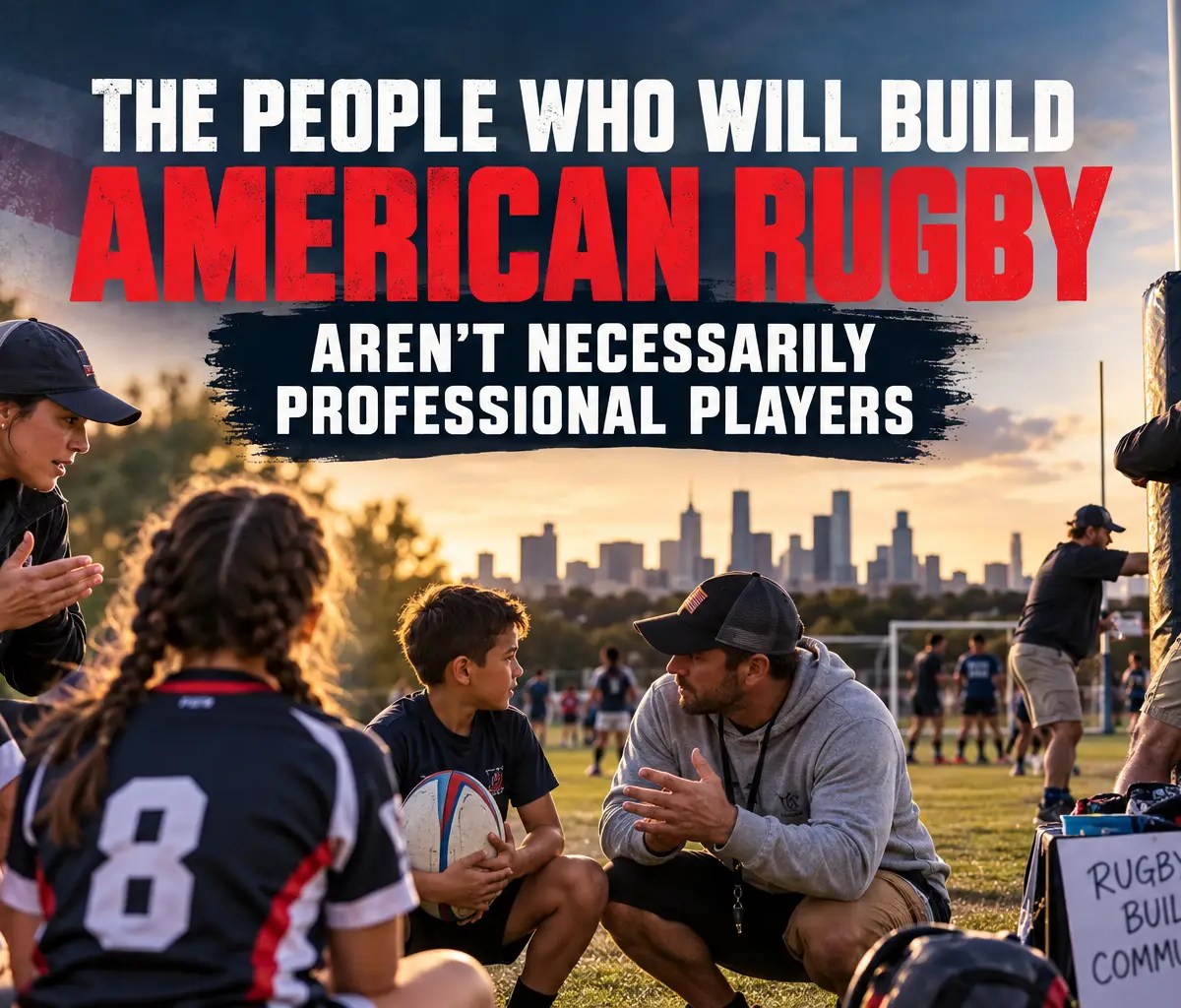
Why the future of rugby in the United States may depend more on teachers, parents, volunteers, and community leaders than the athletes who eventually wear the Eagles jersey.
The Future of American Rugby Starts Somewhere Other Than a Stadium
When conversations turn toward the future of rugby in the United States, they almost inevitably focus on professional players, national team performances, television contracts, and the possibility of establishing a commercially successful domestic competition. These are important pieces of the puzzle, and nobody should underestimate their value. Professional athletes provide the visibility that inspires young people to pick up a rugby ball, while successful national teams give supporters something to rally around. Yet there is a fundamental problem with treating professional rugby as the primary engine of American rugby’s growth. Professional rugby is the product of a healthy rugby ecosystem, not necessarily the foundation upon which that ecosystem is built.
The people who will ultimately determine whether rugby becomes a meaningful part of the American sporting landscape may never receive a professional contract, appear on television, or represent the United States internationally. They are the high school teachers who introduce rugby to students who have never heard of the sport. They are the parents who spend their weekends driving children to tournaments, the volunteers who paint lines on fields before sunrise, and the former players who decide that their contribution to rugby should continue long after their playing careers end. They are the individuals who organize clubs, raise money, recruit new athletes, and convince local communities that rugby deserves a place alongside football, soccer, basketball, and baseball.
If American rugby is going to grow beyond occasional moments of international excitement, it will be because these people build something that lasts when the stadium lights go out.
The Difference Between Building a Professional League and Building a Rugby Culture
American sports have traditionally benefited from deeply established community structures. Football does not begin with the NFL. It begins with children playing flag football, middle school programs, high school rivalries, and communities gathering beneath Friday night lights. Basketball exists in neighborhood parks, school gymnasiums, recreation centers, and driveways long before a talented athlete dreams of reaching the NBA. Baseball has Little League, summer tournaments, and generations of families who understand the sport because they grew up around it.
Rugby does not yet enjoy that same level of cultural familiarity throughout much of the United States. There are established rugby communities, successful college programs, dedicated youth organizations, and regions where the sport has developed strong roots. However, those pockets of success have not consistently translated into the kind of widespread recognition that allows a sport to become part of everyday American life. For many families, rugby remains something they occasionally encounter during the Olympics, an international match, or a highlight circulating on social media.
This distinction matters because building a professional competition and building a rugby culture are two very different undertakings. A professional league can purchase advertising, recruit talented athletes, secure venues, and produce an entertaining product. What it cannot easily purchase is the emotional connection that develops when a community has spent years supporting its local teams. That connection is created through relationships, traditions, participation, and shared experiences. It is built when children grow up playing the sport, parents understand its rules, and former players return to their clubs because those clubs have become part of their identities.
American rugby needs professional ambition, but it also needs to recognize that sustainable growth comes from developing a sporting culture that exists independently of professional success.
The Most Important Rugby Recruiter Might Be a High School Teacher
Consider the influence of a single physical education teacher who decides to introduce rugby during a high school sports unit. Perhaps the teacher has never played the game competitively but has taken the time to understand its fundamentals. Rather than presenting rugby as a complicated foreign sport with unfamiliar terminology, the teacher introduces students to passing, support running, spatial awareness, and the simple objective of moving the ball forward while passing backward.
For many students, this may be their first meaningful exposure to rugby. Some will enjoy the experience and move on. Others may discover that the sport offers something they have been missing in their athletic lives. A football player who rarely touches the ball might enjoy the opportunity to carry, pass, and defend. A soccer player might appreciate the combination of continuous movement and physical contact. A wrestler could discover that tackling and body positioning reward the same balance and leverage developed on the mat.
The teacher has not produced a professional rugby player. At least, not yet. What that teacher has accomplished is arguably more important to the immediate future of the sport: introducing rugby to a group of young Americans who might otherwise never have considered playing it.
Now imagine that experience repeated across hundreds of schools. Imagine physical education departments incorporating non-contact rugby into their curricula, after-school programs offering introductory sessions, and local clubs establishing relationships with school districts. The cumulative impact could be enormous, not because every student would become a competitive rugby player, but because rugby would gradually become familiar rather than foreign.
That is how a sport begins to establish itself within a culture. Not every child who plays basketball dreams of becoming a professional, but almost every American understands what basketball is. Rugby needs to move toward that same level of familiarity, and educators could become some of its most influential ambassadors.
Parents Are the Gatekeepers of Youth Sports
One of the most overlooked realities of youth sports development is that children rarely make athletic decisions entirely on their own. Parents determine which activities fit into family schedules, which organizations they trust, and where they are willing to invest their time and money. They research programs, communicate with coaches, arrange transportation, and evaluate whether an athletic environment is safe, organized, and beneficial for their children.
For rugby, this presents both a challenge and an opportunity. Many American parents are unfamiliar with the sport, and unfamiliarity can quickly become hesitation, particularly when rugby is associated with physical contact. A parent who understands football may feel comfortable enrolling a child in a football program because the sport’s structure and expectations are familiar. That same parent might hesitate when presented with rugby, even if an age-appropriate introductory program emphasizes non-contact play, progressive skill development, and qualified coaching.
The solution is not simply to tell parents that rugby is a wonderful sport. Rugby organizations must demonstrate that they are responsible, accessible, and capable of providing positive experiences for young athletes. That means clearly communicating safety protocols, explaining the differences between non-contact and contact formats, maintaining appropriate coaching standards, and ensuring that parents feel welcome rather than intimidated by unfamiliar traditions.
Once parents become comfortable with rugby, they often become essential contributors to its survival. They organize fundraisers, coordinate travel, recruit other families, and help clubs navigate the practical challenges of operating youth sports programs. Some become coaches, administrators, or board members. Others simply become enthusiastic supporters who introduce the sport to friends and neighbors.
A successful youth rugby club does not merely recruit players. It recruits families, and those families can become the foundation of a rugby community that continues for generations.
The Volunteer Who Keeps the Club Alive


There is a particular kind of person who exists in almost every grassroots rugby organization. They arrive before everyone else, leave after everyone has gone home, and somehow manage to handle a dozen responsibilities without receiving much recognition. They coordinate field reservations, manage registration paperwork, organize equipment, answer emails, collect dues, and make sure the club has enough money to finish the season.
They are not always the most talented former players. They may never have played beyond the recreational level. Some became involved because their children joined a team, while others discovered rugby as adults and developed a lasting affection for the community surrounding it. What they share is a willingness to contribute time and energy to something they believe deserves to exist.
American rugby depends heavily on these individuals, but dependence creates a vulnerability when organizations fail to develop sustainable leadership structures. Too many amateur sports clubs operate through the extraordinary efforts of a handful of people. When those individuals move away, experience burnout, or face changing family responsibilities, the organization can struggle to replace them.
If rugby wants to grow, it must become better at supporting the people who perform this work. Clubs need clear administrative processes, leadership succession plans, accessible coaching education, and practical resources that reduce the burden on volunteers. Regional and national rugby organizations should measure their success not only through player participation but also through the health and stability of the clubs responsible for creating those opportunities.
A club that has existed for twenty years and continues introducing new people to rugby is a tremendous sporting asset. Its survival should matter just as much to the broader rugby community as the results of a professional match.
Former Players Have a Responsibility Beyond Their Playing Careers
One of rugby’s greatest potential advantages is the loyalty many players develop toward the sport. Rugby often creates unusually strong bonds through shared physical challenges, teamwork, travel, and the social traditions surrounding club life. Those relationships can endure long after athletes have played their final competitive match.
Yet American rugby cannot afford to treat former players simply as retired participants. They represent an enormous pool of potential coaches, referees, mentors, administrators, and advocates. A former college player who establishes a youth program in a community without rugby may ultimately contribute more to the sport’s long-term development than someone who enjoyed a more successful playing career but never became involved again.
This is not a criticism of professional athletes or elite competitors. Their achievements are valuable, and many already dedicate considerable effort to growing the game. Rather, it is a reminder that the responsibility for developing rugby cannot rest exclusively on those who reach its highest levels.
A former prop who teaches young athletes the fundamentals of scrummaging, a retired scrumhalf who coaches decision-making, or a former collegiate captain who helps establish a women’s club can each make an enduring contribution. Their knowledge becomes especially valuable when they recognize that introducing beginners to rugby requires patience, encouragement, and an understanding that not everyone shares their experience.
The objective should be to create a culture in which remaining involved in rugby after retirement is normal rather than exceptional. Former players should see coaching, officiating, mentoring, and club administration as natural extensions of their participation in the sport.
If even a modest percentage of former American rugby players became actively involved in introducing the next generation, the cumulative effect could reshape the country’s grassroots infrastructure.
Referees, Administrators, and Organizers Deserve a Place in the Conversation
Rugby development discussions frequently emphasize the need for more players and better coaches, but a growing sport also requires people capable of organizing and sustaining competition. Without referees, matches cannot take place. Without administrators, clubs struggle to maintain schedules, registrations, insurance, and financial accountability. Without event organizers, tournaments become difficult to coordinate, and opportunities for meaningful competition disappear.
These roles rarely attract attention because they operate behind the scenes. Yet their importance becomes obvious whenever there are too few qualified officials to cover a weekend of matches or when a promising new club discovers that the administrative responsibilities of running an organization are far more demanding than expected.
American rugby should treat referee recruitment and administrative development as essential parts of its growth strategy. Former players who no longer wish to compete physically may find officiating rewarding. Parents with professional experience in accounting, marketing, law, fundraising, or organizational management may be able to strengthen clubs without ever stepping onto the field. Community leaders who understand local government and recreation departments may help organizations secure facilities or establish partnerships.
These contributions do not make for exciting highlight reels, but they make the highlight reels possible in the first place.
A sport cannot expand sustainably if its participation grows faster than its ability to organize, supervise, and support that participation. Rugby needs more than athletes. It needs the infrastructure that allows athletes to compete.
The Business Community Could Be Rugby’s Most Underused Partner
There is another group of potential rugby builders that deserves greater attention: local business owners and community sponsors. In many American towns, youth and amateur sports organizations survive because businesses are willing to contribute money, equipment, facilities, or professional expertise. The sponsorship may be modest, perhaps a few hundred dollars toward uniforms or tournament expenses, but the effect can be significant for a small club operating on limited resources.
Rugby organizations sometimes approach sponsorship primarily as a financial transaction. A business contributes money in exchange for a logo on a jersey or a banner beside the field. While that arrangement has value, the greater opportunity is developing genuine relationships between rugby clubs and the communities in which they operate.
A local restaurant that hosts a club’s post-match gatherings becomes part of its social identity. A construction company that helps maintain facilities contributes directly to the organization’s stability. A healthcare provider that supports appropriate injury prevention and medical planning can help improve player welfare. An employer that accommodates the schedules of volunteer coaches may be supporting rugby just as meaningfully as a traditional financial sponsor.
These relationships also help rugby become more visible within everyday community life. When local businesses recognize rugby clubs as worthwhile organizations, the sport begins to develop credibility beyond its existing participants.
American rugby does not need every sponsor to be a national corporation. It needs thousands of smaller partnerships that make local participation more affordable, accessible, and sustainable.
Women’s Rugby Offers a Chance to Build Something Different
The growth of women’s rugby in the United States provides an opportunity to reconsider how sporting communities are developed. Rather than attempting to replicate every aspect of traditional men’s sporting structures, women’s rugby can help demonstrate the value of creating inclusive, community-centered pathways from the beginning.
The emergence of Women’s Elite Rugby offers an important professional destination and a platform for showcasing elite female athletes. However, the long-term significance of professional women’s rugby will depend partly on whether its visibility translates into opportunities for girls and women to participate locally.
A young girl watching a professional rugby match needs more than inspiration. She needs somewhere to play. She needs a coach who understands how to introduce the game, teammates who welcome her, and an organization capable of providing a positive experience. In many communities, establishing those opportunities will require the efforts of people who have never played professional rugby and never expect to.
Female coaches, former collegiate players, educators, parents, and community organizers could become some of the most important figures in this development. Their ability to establish sustainable programs may ultimately determine whether professional women’s rugby becomes the visible peak of a broad participation base or remains a relatively isolated achievement.
The opportunity is not simply to produce better players for the national team. It is to make rugby a realistic sporting option for girls who might otherwise never encounter it.
The 2031 and 2033 World Cups Cannot Be the Entire Strategy
The United States is scheduled to host the Men’s Rugby World Cup in 2031 and the Women’s Rugby World Cup in 2033. These tournaments represent extraordinary opportunities to introduce rugby to American audiences, attract commercial investment, and demonstrate the sport’s international appeal.
However, the presence of a major sporting event does not automatically create a lasting participation culture. Spectators can enjoy an international match without developing any intention of joining a club, enrolling their children in a program, or attending another rugby event. The challenge is converting temporary excitement into sustained involvement.
This is where grassroots rugby builders become indispensable. A community with an established youth program, qualified coaches, functioning clubs, and accessible competitions is far better positioned to capitalize on World Cup interest than a community where enthusiastic spectators have nowhere to experience the sport themselves.
The years leading up to these tournaments should therefore be treated as an opportunity to strengthen local rugby infrastructure. That means helping new clubs become established, supporting existing organizations, recruiting and training coaches, improving access to facilities, and developing introductory programs that welcome beginners.
Imagine a family attending a World Cup match in 2031. Their child becomes fascinated with rugby and asks whether they can try playing. If a local club offers an introductory session the following weekend, that moment of enthusiasm has somewhere to go. If the nearest program is an hour away, difficult to find, or unable to accept new players, the opportunity may disappear.
The World Cups can create interest. The people working at the community level will determine whether that interest becomes participation.
Stop Measuring American Rugby’s Success Only at the Top
Perhaps the most important change American rugby needs is a broader understanding of what success actually looks like. National team rankings, professional attendance, broadcast audiences, and commercial partnerships are useful indicators of progress, but they cannot tell the entire story of whether the sport is becoming healthier.
A more complete assessment would also consider how many youth clubs are operating sustainably, how many schools introduce rugby, how many qualified referees are available, and whether new participants continue playing after their first season. It would examine whether clubs have strong leadership, whether women’s and girls’ programs are expanding, and whether families can find affordable opportunities to participate close to home.
These measures may not generate headlines, but they provide insight into whether American rugby is building a foundation capable of supporting long-term growth.
A national team victory is worth celebrating. A professional competition attracting new supporters is an encouraging development. But a community establishing its first sustainable youth rugby club should also be recognized as a meaningful achievement.
The success of American rugby cannot be measured exclusively by the performance of its best players. It must also be measured by the opportunities available to everyone else.
The People Who Build the Game Are Often the Ones Nobody Sees
Somewhere in the United States, a volunteer coach is preparing for a Saturday morning practice. They are checking the weather, organizing equipment, and wondering whether enough players will arrive to run the session they planned. A parent is helping a child find a missing mouthguard. A referee is driving to a match that will attract only a few dozen spectators. A club treasurer is working through registration payments and trying to determine whether the organization can afford another set of jerseys.
None of these people is thinking about television contracts or international rankings. They are thinking about the immediate responsibilities that keep rugby alive in their communities. Their work is repetitive, sometimes frustrating, and rarely celebrated outside the small circles of people who benefit from it.
Yet these are the people who are building American rugby.
The future Eagles captain might be attending one of those practices. A future professional women’s rugby player might be participating in her first introductory session. A future coach, referee, or club president might be discovering the sport for the first time. The individuals responsible for creating those opportunities may never know the full extent of their influence.
And perhaps that is the point.
The future of rugby in America will certainly feature professional players, international stars, and major sporting events. Those individuals and occasions will inspire people, attract attention, and demonstrate what the sport can become. But inspiration alone does not create a sporting culture. Someone must take that inspiration and turn it into an opportunity that exists in a neighborhood, a school, or a community.
American rugby will not be built solely by the people who reach the highest levels of the game. It will be built by the people who make sure there is a game for everyone else to play.
And when we look back years from now to understand how rugby finally established deeper roots in the United States, we may discover that its most important builders were never professional players at all.
WHAT DO YOU THINK?
Share your take on the match, the players, or the future of rugby. Keep it respectful and on topic.