
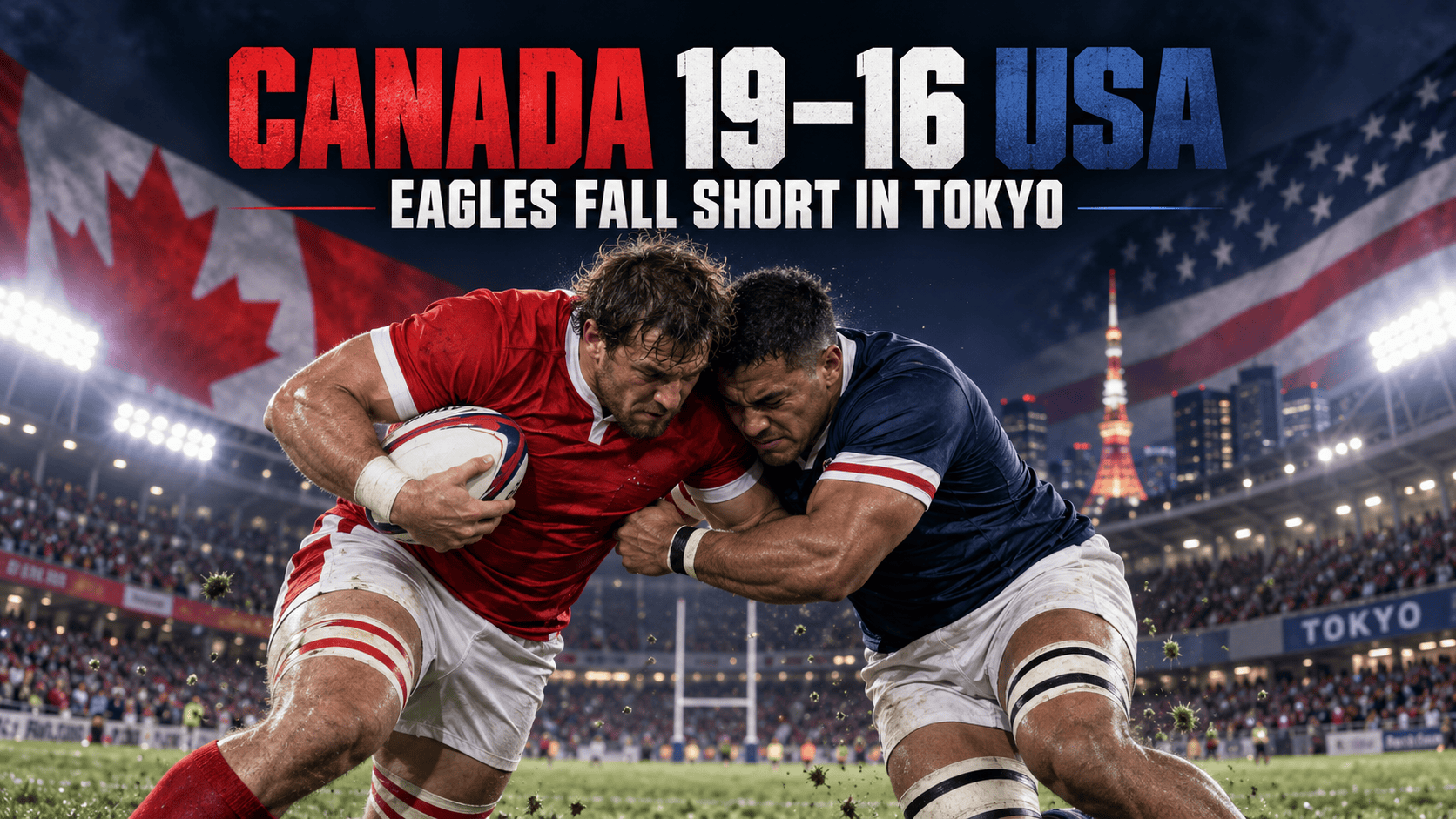
The United States recovered from a disastrous opening, but poor execution and another failure to finish under pressure allowed Canada to claim third place in the Pacific Nations Cup.
The United States entered Saturday’s Pacific Nations Cup third-place playoff with an opportunity to finish its campaign on a positive note and reclaim some momentum against its oldest rival. Instead, the Eagles left Tokyo with another frustrating defeat after Canada survived a dramatic final stand to win 19–16.
The result was decided by only three points, but the match exposed a familiar problem for the United States: the Eagles showed enough quality to compete, yet not enough consistency to control the contest or finish it when the opportunity arrived.
Canada Punishes a Slow Start
The United States spent the opening 20 minutes chasing the match.
Canada struck first through Ben LeSage following a well-designed lineout move in the 10th minute. Seven minutes later, an overthrown American lineout gave Canada another attacking opportunity. Cooper Coats broke through the defensive line before the ball eventually reached Mason Flesch, who finished in the corner to give Canada a 12–0 advantage.
The two tries demonstrated Canada’s early sharpness. The Canadians did not dominate through long periods of possession; they simply recognized opportunities and punished American mistakes.
For the Eagles, the opening quarter was defined by defensive disorganization and inaccurate execution. Against a rival as familiar and evenly matched as Canada, conceding 12 unanswered points created a margin for error that the United States could never fully recover.
The Eagles Find Their Way Back
To their credit, the Americans did not allow the match to escape.
Prop Fakaosifolau Pifeleti provided the response in the 21st minute, running onto a well-timed cutout pass from Ruben de Haas and powering through the Canadian defense. Luke Carty converted before adding a penalty shortly before halftime, reducing Canada’s lead to 12–10.
Carty then kicked another penalty three minutes into the second half, completing the American comeback and giving the Eagles their first lead at 13–12.
That stretch represented the best portion of the match for the United States. The Eagles improved their physicality, played with greater patience and began forcing Canada into defensive work. After such a difficult beginning, taking the lead should have provided the platform to seize control.
Instead, the momentum quickly disappeared.
Canada Wins the Decisive Moments
Canada reclaimed the lead in the 59th minute. Flesch carried powerfully into the American 22, the Canadian forwards maintained the pressure, and scrum-half Jesse Kilgour eventually picked from close range to score his first international try.
Takoda McMullin’s conversion pushed Canada ahead 19–13.
Flesch, who had already scored Canada’s second try, was named Player of the Match after influencing several of the game’s most important moments. His ability to carry through contact and generate forward momentum gave Canada a reliable attacking option whenever the match became tight.
The United States closed the gap through Carty’s third penalty in the 72nd minute, leaving the Eagles one score away at 19–16.
That set up a frantic conclusion.
One Final Opportunity
During the final passage, the Eagles worked through nine phases inside the Canadian five-meter area. After Canada was penalized for offside, the United States elected to take a scrum and pursue the winning try rather than attempt a penalty that could have tied the match.
It was an aggressive decision—and an understandable one. With Canada under pressure and the American forwards already positioned near the line, the Eagles backed themselves to win.
But the decision demanded precise execution.
Canada’s defense remained composed, and captain Lucas Rumball produced the defining intervention at the breakdown. The American attack ended with a costly error, allowing Canada to escape with the victory. Rugby Canada described Rumball’s late work over the ball as the decisive act in Canada’s defensive stand.
The final sequence summarized the entire American performance: plenty of effort, a genuine opportunity, but insufficient accuracy when the match demanded it most.
Encouraging Fight, Familiar Problems
There were positives for the Eagles. Recovering from 12–0 down to take the lead showed resilience. Carty contributed 11 points from the tee, Pifeleti gave the attack a needed physical spark, and the United States remained competitive until the final play.
But international rugby is rarely decided by effort alone.
The inaccurate lineout that helped create Canada’s second try was particularly damaging. So was the inability to turn a 13–12 lead into sustained pressure. The Eagles repeatedly fought their way into the contest without ever imposing themselves on it.
Canada, by comparison, was more clinical. The Canadians scored three tries, capitalized on American mistakes and trusted their defense when the match reached its decisive stage. Kilgour’s second-half score ultimately separated the teams, while Flesch and Rumball delivered the individual moments Canada needed. World Rugby confirmed the victory secured third place for Canada in the 2026 Pacific Nations Cup.
What Comes Next for the Eagles?
The narrow scoreline should not disguise the larger concern.
The United States continues to demonstrate that it can compete with teams at this level. The more important question is whether it can begin winning these matches consistently. That requires better starts, more reliable set-piece execution and greater composure inside the opposition’s 22.
Saturday was not a collapse. It was something potentially more frustrating: a winnable match that slipped away through small but decisive failures.
Canada finished third because it handled the critical moments better. The Eagles finished fourth because, once again, their best rugby appeared only after they had placed themselves in trouble.
With the 2027 Rugby World Cup approaching, competitive performances are no longer enough. The United States must learn how to convert pressure into points, possession into control and late opportunities into victories.

Leave a Reply